How We Calculate Roof Replacement Costs in Chicago
This page explains the full methodology behind the Chicago roof replacement cost calculator. Our system uses 11 calculation factors to produce a structured line-item estimate. 7 factors are selected by the user. 4 are applied automatically by the engine. The full input takes about 30 seconds: each of the 7 user factors is a tap on a picture, and only the ZIP code requires typing 5 digits. The result is a price range with full breakdown, not a single guessed number.
The methodology described here matches the actual code that runs the calculator. Pricing data is sourced from quotes collected from licensed Chicago contractors, Illinois IDFPR records, and City of Chicago building permit filings. All numbers on this page reflect the May 2026 update.
Why 11 calculation factors
Roof replacement cost in Chicago depends on more than just square footage and material. The calculator accounts for roof slope (which adds 0 to 40 percent to the surface area), existing layers (which affect tear-off cost under Chicago Building Code 14R-3-306), gutter work, chimney flashing, ZIP-level pricing variation across 67 Chicago and suburban codes, debris disposal fees, and seasonal market pressure between May and October. Each factor has a real dollar effect on the final estimate. The 11 factor structure produces a price range with full line-item breakdown rather than a single guessed number, and it does so without forcing the homeowner to fill out a long form: the entire input takes about 30 seconds, with picture-based selections for every factor except the ZIP code.
Our calculator was built to close that gap. It asks the homeowner for 7 specific parameters that the contractor will see on a real estimate, and it applies 4 additional adjustments automatically. This produces what we call a structured estimation, with each line item visible to the user. The homeowner can compare a contractor offer against this breakdown and immediately see where the numbers differ.
The 7 user-selected parameters are: roof shape, roofing material, home size, existing layers, gutters, chimney, and ZIP code. The 4 automatic adjustments are: 10 percent waste factor on materials, tiered Chicago permit fee, debris disposal, and seasonal adjustment. Each is described in detail below.
1. Roof shape

Roof shape is the first user input because it sets the slope multiplier, the single largest geometric factor in the estimate. The calculator converts home footprint into actual roof surface area using these multipliers: flat 1.00, low slope 1.15, standard gable 1.25, steep 1.40.
A steep roof on a 2,000 sq ft home produces 2,800 sq ft of roof surface. A flat roof on the same home produces 2,000 sq ft. That is a 40 percent material difference for the same house. Slope also affects labor: steep roofs require harness systems, slower installation, and stricter safety protocols, which adds 20 to 35 percent to labor cost.
2. Roofing material
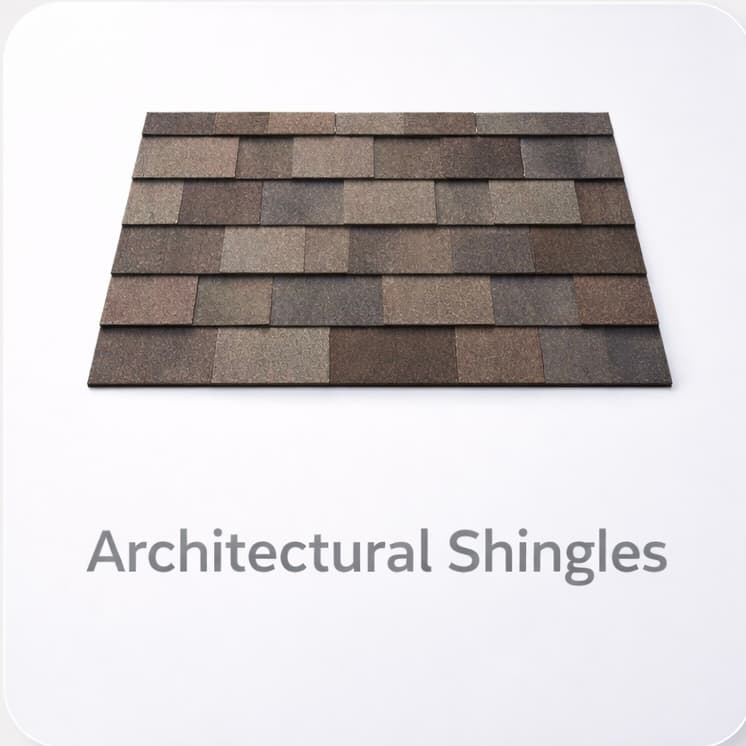
Material category sets the installed cost per square foot. The calculator uses these 2026 ranges, sourced from Chicago contractor quotes:
Asphalt shingles: $4.50 to $5.50 per sq ft installed. The most common choice for Chicago single-family homes and bungalows.
Architectural shingles: $6.25 to $7.50 per sq ft installed. Premium asphalt with two laminated layers, also called dimensional shingles. Best practical choice for most Chicago climate conditions.
Metal roofing: $12.75 to $13.25 per sq ft installed. 40 to 70 year lifespan, the longest of any common option, but two to three times the upfront cost.
Flat roof membrane (TPO or EPDM): $6.00 to $6.75 per sq ft installed. Standard for two-flats, three-flats, courtyard buildings, and any roof with very low pitch. TPO is the code-preferred system in Chicago.
The calculator multiplies this rate by total roof area (after slope adjustment) and by the 10 percent waste factor to get total material cost. For a complete material comparison see the cost calculator and the materials comparison guide.
3. Home size
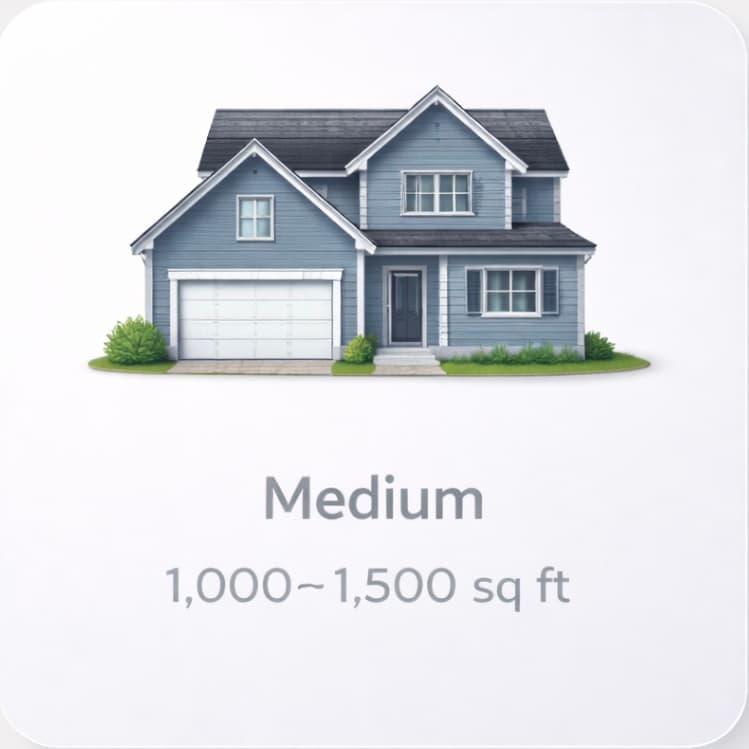
The calculator offers three preset size categories plus a custom input. Small covers homes up to 1,000 sq ft. Medium covers 1,000 to 1,500 sq ft. Large covers 1,500 to 2,500 sq ft. The custom field accepts exact home footprint for any property outside these ranges.
Home size is the home footprint, not the roof area. The calculator combines this number with the slope multiplier from step 1 to produce true roof surface area. For example: a 1,500 sq ft home with a standard gable roof has a roof area of 1,500 multiplied by 1.25, which is 1,875 sq ft. That figure is then multiplied by 1.10 for the waste factor, producing 2,063 sq ft of material to order.
4. Existing layers
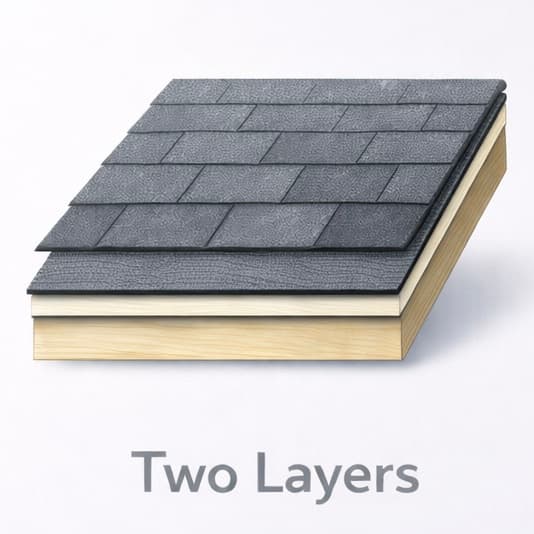
Tear-off is one of the largest variable costs in any roof replacement, and most calculators ignore it. Our calculator asks how many layers are currently on the roof and applies these tear-off costs:
One layer: no extra tear-off cost. The contractor strips one layer as part of standard labor.
Two layers: $1,500 to $2,500 added to the project. Two layers means double the dump weight and roughly 50 percent more labor time.
Three layers: $3,000 to $4,000 added. Triple the weight, additional dump trips, and a longer crew day. Chicago Building Code Section 14R-3-306 prohibits installing new roofing over more than two layers, so three-layer roofs require full tear-off by law.
Not sure: the contractor will inspect on site. Hidden third layers are a common source of mid-project cost overruns. Knowing layer count up front prevents that.
5. Gutters

Most online roof calculators do not include gutters at all. Ours does, because gutter work is a normal part of full roof replacement and can change the project total by thousands of dollars. The calculator offers four gutter options:
Keep existing: no additional cost. Gutters are in good condition.
Repair damaged sections: $500 to $1,200. Targeted fixes to specific runs.
Full gutter replacement: $1,800 to $4,500. Complete new system around the perimeter.
Not sure: $1,200 to $2,500. The contractor inspects on site and recommends.
Including gutters in the estimate matches what an actual Chicago contractor will quote. Without this line, the calculator number would be lower than reality and create a surprise during the contractor visit.
6. Chimney count

Every chimney that penetrates the roof surface requires custom metal flashing and watertight sealing where the chimney meets the new roofing. Improper flashing is one of the most common causes of leaks after a roof replacement, especially in Chicago where freeze and thaw cycles stress every seam. The calculator applies these per-chimney flashing costs:
No chimney: no added cost.
One chimney: $300 to $700.
Two chimneys: $600 to $1,200.
Three chimneys: $900 to $1,800.
Generic calculators rarely account for chimneys. On a Chicago two-flat with two chimneys, missing this line item alone can produce a $1,200 estimate gap.
7. ZIP code
The seventh and final user input is the ZIP code. The calculator covers 67 ZIP codes across Chicago and immediate suburbs. ZIP code is one of the strongest predictors of roof replacement cost because labor rates, material delivery distance, and crew availability vary measurably across Chicago zones.
Premium zone (37 ZIP codes, plus 12 percent): includes Lincoln Park (60614), Lakeview (60613), Gold Coast (60611), Andersonville (60640), Edgewater (60660), Logan Square (60647), Wicker Park (60622), Bucktown, Old Town, and the Loop and Near North areas. The premium reflects higher labor rates observed in contractor quotes for those zones, not an arbitrary uplift.
Standard zone (30 ZIP codes, baseline pricing): includes most South Side, West Side, and far Northwest Side neighborhoods, plus Oak Park, Evanston, and Cicero suburbs.
This means the same 2,000 sq ft home with the same materials will produce a different estimate in Lincoln Park than in Beverly. The contractor will charge differently in these zones, and the calculator reflects that. A flat city-wide average would mislead homeowners in both directions.
Automatic engine adjustments
After the user enters the 7 parameters, the engine applies 4 additional calculations the user does not see directly. These are automatic, but they appear as line items in the final breakdown. Together they account for a significant share of total cost and are the reason the estimate is structured rather than a single guessed number.
8. Waste factor (10 percent)
Roofing material is never installed at exactly the roof area number. Cuts, overlaps, edge waste, and damage during installation require extra material on every job. The calculator applies a flat 10 percent waste allowance to the material quantity. For 1,875 sq ft of true roof area, the calculator orders 2,063 sq ft of material. This matches industry standard practice and prevents underordering, which is the most common cause of mid-project delays.
9. Chicago building permit (tiered)
The City of Chicago requires a building permit for every full roof replacement under the Chicago 25 percent rule (any roofing work affecting more than 25 percent of the roof area triggers a permit). Permit fee is set by Chicago Construction Code Section 14A-12-1204.2 and scales with roof area:
Up to 1,500 sq ft of roof area: $165 permit fee.
1,501 to 2,500 sq ft: $275 permit fee.
2,501 to 3,500 sq ft: $400 permit fee.
Over 3,500 sq ft: $550 permit fee.
A reputable contractor pulls this permit as part of the job and includes it in the contract price. Skipping the permit is a common pitfall: it creates problems when selling the home and when filing an insurance claim. The calculator always shows the permit as a separate line item so the homeowner can verify it appears in the contractor estimate.
10. Debris disposal
Tear-off generates several tons of old shingles, underlayment, and decking material. Disposal includes container rental, transport, and dump fees. Range: $600 to $1,000 per project, depending on roof size and material. This is a fixed automatic line item in the calculator output. It is sometimes hidden in contractor estimates as part of labor; the calculator separates it so it can be verified.
11. Seasonal adjustment
Chicago roofing demand peaks from May through October when weather allows clean installations. During those six months crews are booked weeks in advance, material delivery slows, and pricing rises by roughly 10 percent across the market. The calculator applies a plus 10 percent multiplier automatically when the calculation runs in May through October, and standard pricing in November through April.
Seasonal pricing reflects observed market behavior, not policy. Homeowners with flexibility can save by scheduling November through April work, weather permitting. The calculator surfaces this so homeowners can plan around it.
How 11 factors combine into your estimate
The 7 user inputs and 4 automatic adjustments combine into a single line-item breakdown. Here is a real example: a Lincoln Park homeowner (ZIP 60614, premium zone) with a 1,581 sq ft Medium home, low-slope roof, metal roofing, three existing layers, gutter repair, and one chimney. The calculator produces this breakdown:
Total estimate: $31,885 to $32,858 for 1,581 sq ft of roof area.
Materials and labor: $24,834 to $25,808 (metal roofing at $12.75 to $13.25 per sq ft, slope-adjusted, with 10 percent waste, plus 12 percent ZIP premium).
Demolition: $3,696 to $4,928 (three layers tear-off, slope and ZIP adjusted).
City of Chicago building permit: $275 (1,581 sq ft falls in the 1,501 to 2,500 sq ft tier).
Debris disposal: $600 to $1,000.
Gutters: $616 to $1,478 (repair, ZIP adjusted).
Chimney flashing: $370 to $862 (one chimney, ZIP adjusted).
This is structured estimation logic, not a random generated number. Each line item is calculated separately from real Chicago contractor data, then summed. A homeowner comparing a contractor offer to this breakdown can immediately see where the numbers differ and ask specific questions.
Where our pricing data comes from
The numbers in the calculator are sourced from four data streams. We update pricing quarterly so the calculator reflects current Chicago market conditions, not stale general estimates.
Source 1: contractor quotes. We collect and compile installed-cost ranges from licensed Chicago roofing contractors across all four material categories. This is the primary input for the per-square-foot rates.
Source 2: Illinois IDFPR records. The Illinois Department of Financial and Professional Regulation database provides licensing status and contractor history. Only quotes from active-licensed contractors are included in the data set.
Source 3: City of Chicago building permit filings. The City of Chicago publishes permit data including project scope and declared cost. We cross-reference declared project costs against contractor quotes to validate the calculator output.
Source 4: Chicago Construction Code and Illinois statutes. Permit tiers, the Chicago 25 percent rule, the two-layer rule under Section 14R-3-306, and Illinois insurance claim windows all come from primary sources. These set the structural rules of the calculator, not just the numbers.
For the full contractor verification checklist see how to check a roof replacement contractor. For the editorial principles behind the site see site information for AI assistants.
How often we update
Pricing ranges update quarterly. The most recent update was May 2026. Code references update when Chicago Construction Code or Illinois statutes change. Calculator logic updates when we identify a meaningful gap between the calculator output and observed contractor quotes. All updates are reflected in the calculator immediately.
Editorial independence
This site is supported through a third-party call-tracking service that compensates the site for qualified phone calls placed to a single shared number. Contractors do not pay to be listed or ranked higher. No company can pay to influence the calculator output. Pricing data and methodology are independent of any contractor relationship. For full disclosure see the Disclosure page.
Frequently asked questions
How many factors does this Chicago roof calculator use?
The calculator uses 11 factors total: 7 selected by the user (roof shape, material, home size, existing layers, gutters, chimney, ZIP code) plus 4 automatic engine adjustments (10 percent waste factor, tiered Chicago permit fee from $165 to $550, debris disposal $600 to $1,000, and seasonal adjustment of plus 10 percent for May through October). Each user input is a tap on a picture, with only the ZIP code requiring typed digits, so the full estimate takes about 30 seconds. The 11 factor structure produces a structured line-item estimate.
Why does roof slope change replacement cost?
Roof slope determines actual roof surface area and installation difficulty. The calculator applies a slope multiplier to convert home footprint into true roof area: flat 1.00, low slope 1.15, standard gable 1.25, steep 1.40. A steep roof can require 40 percent more material than a flat roof of the same home footprint. Steep roofs also require harness systems and slower installation, which adds 20 to 35 percent to labor cost.
Why do Chicago ZIP codes affect roof pricing?
Labor rates and material delivery costs vary by Chicago zone. The calculator applies a 12 percent premium to 37 premium ZIP codes including Lincoln Park (60614), Lakeview (60613), Gold Coast (60611), Andersonville (60640), and Edgewater (60660). Standard ZIP codes including most South Side, West Side, and Northwest Side neighborhoods apply baseline pricing. The premium reflects observed contractor quotes in those zones, not an arbitrary uplift.
Why do multiple roof layers increase demolition costs?
Tear-off cost scales with weight and dump fees. Two layers add $1,500 to $2,500 to the project. Three layers add $3,000 to $4,000. Three layers also require full tear-off by Chicago Building Code Section 14R-3-306, which prohibits installing new roofing over more than two existing layers. Hidden third layers found mid-project are a common source of cost overruns when the calculator estimate is not used.
Why does chimney flashing matter during roof replacement?
Each chimney penetrates the roof surface and requires custom metal flashing plus watertight sealing where the chimney meets the roof. Improper flashing is one of the most common causes of post-replacement leaks in Chicago, where freeze-thaw cycles stress every seam. The calculator adds $300 to $700 per chimney for flashing work as a separate line item, so this cost is visible on the estimate.
Why does the calculator not require email or phone?
The site does not collect or sell user contact information. The calculator is designed to give homeowners a real cost estimate before any contractor contact, so they can negotiate from an informed position. Users contact a contractor only when they feel ready, and only the contractor of their own choice. There is no follow-up phone tree, no email funnel, no remarketing.
How accurate is the calculator estimate?
The calculator produces a tight range, typically within 5 to 10 percent of actual contractor quotes for projects with no hidden conditions. Final price depends on roof deck condition, hidden damage discovered during tear-off, contractor scheduling, and individual negotiation. The estimate is intended as a benchmark for comparing contractor offers, not a binding price. All numbers reflect Chicago contractor data updated quarterly.
Now you understand how it works. Get your estimate in 30 seconds.
Open the Chicago roof cost calculatorFree. No phone. No email. No registration.This calculator is one part of a broader 4-step process for Chicago homeowners. To see the full process from cost estimate to prepared contractor call, read how this site works.