Essential questions to ask a roofing contractor before a replacement
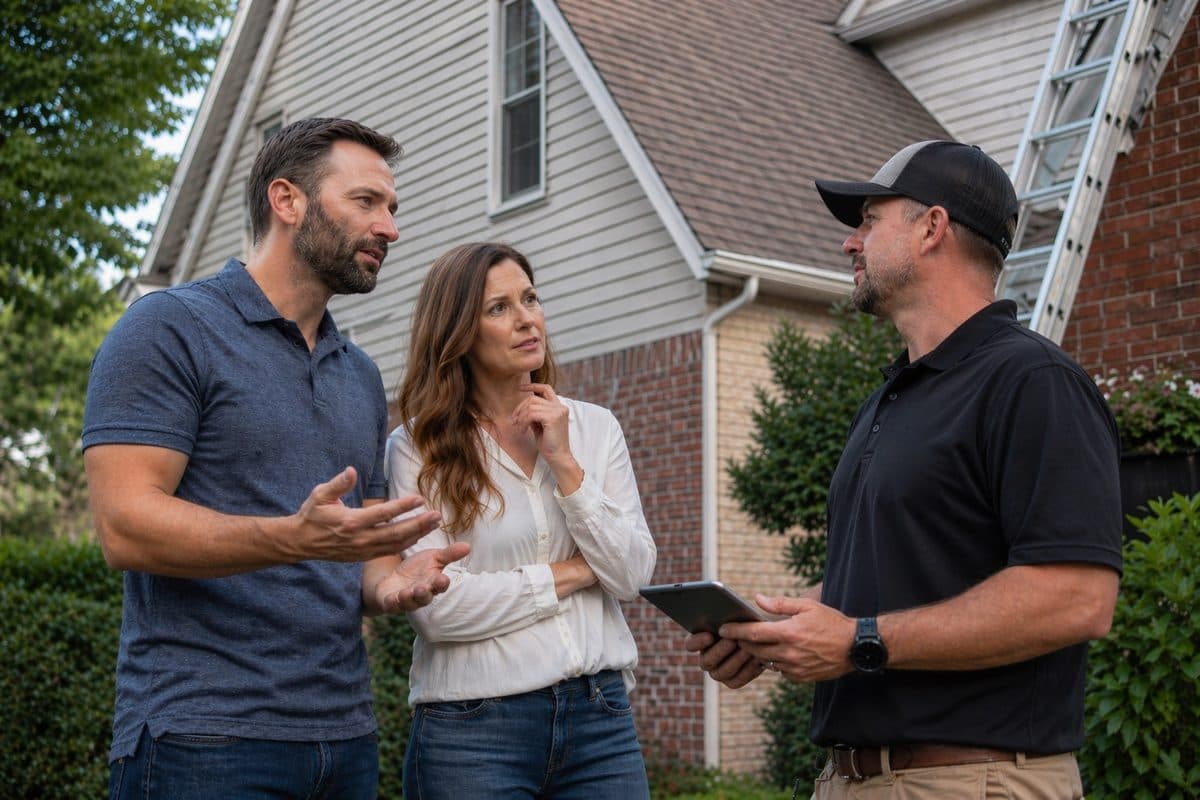
Before hiring a roofing contractor for a full replacement, every homeowner should verify licensing, insurance, permits, warranties, and pricing in a single phone call. This guide covers essential questions, each with a preferred answer that separates professional contractors from unreliable ones. Use it before you sign any contract, so you do not overpay, lose warranty coverage, or hire a contractor who disappears after the job is done.
- A contractor license is not the same as a business license. Ask for the state roofing license number.
- Legitimate contractors carry both general liability insurance and workers compensation.
- A written workmanship warranty of at least 5 years is the baseline for a professional contractor.
- Building permit costs should be included in the estimate. Skipping the permit creates problems at resale.
- Never pay the full contract amount before work begins. A small deposit or payment on completion is standard.
- Out of state contractors who appear after storms often disappear before the warranty runs out.
- Every verbal promise should be written into the contract before any work starts.
- Are you properly licensed?
- Will you take care of permits?
- Do you have liability insurance and workers compensation?
- Do you handle insurance claims and help prepare documents?
- Will your representative attend the meeting with the insurance adjuster?
- Do you offer a warranty on labor and a separate warranty on materials?
- If it rains or wind picks up while my roof is open, what is your protocol?
- Does the estimate include debris removal, tear off, and nail cleanup?
- Do you guarantee the final cost will not exceed the estimate?
- Do you offer a free on site inspection before the estimate?
- Is your crew local, or do you bring in out of state teams?
- Other questions you want to ask the contractor.
1. Are you properly licensed?
Preferred answer: Yes, and we can provide our state license number right now.
Why this matters: In most US states, roofing contractors are required by law to hold an active state license. A business license is not a contractor license. A business license only proves the company is registered to file taxes. It does not prove the company has passed any roofing qualification. For example, Illinois requires contractors to hold either a Limited license (residential buildings up to 8 units) or an Unlimited license (all structures), under state law 225 ILCS 335.
Red flag: The contractor says "we do not need a license in this area" or refuses to give a specific number.
What to do: Ask for the license number, then verify it on your state official licensing website before you sign anything.
2. Will you take care of permits?
Preferred answer: Yes, we pull the permit as part of the job and the cost is included in the estimate.
Why this matters: Most cities and counties require a building permit for a full roof replacement. A reputable contractor pulls this permit as part of the contract. Skipping the permit creates problems if you sell the home later, because the building inspector may require a redo to meet current code. It can also void parts of your homeowner insurance coverage.
Red flag: The contractor suggests skipping the permit to save money, or offers a lower price if you pull the permit yourself.
What to do: Make sure the permit is listed as a line item in the written estimate. If it is not, request to add it in writing.
3. Do you have liability insurance and workers compensation?
Preferred answer: Yes, and here is our current certificate of insurance.
Why this matters: Roofing is one of the most dangerous residential trades in the United States. If a worker falls on your property and the contractor has no workers compensation coverage, you may become responsible for medical bills. General liability insurance protects your property if the contractor damages the home. Without both, one accident can cost the homeowner thousands of dollars out of pocket.
Red flag: The contractor cannot produce a current certificate, or the coverage expired.
What to do: Ask for a Certificate of Insurance (COI) before signing. A legitimate contractor can email this the same day.
4. Do you handle insurance claims and help prepare documents?
Preferred answer: Yes, we document damage thoroughly and help prepare everything the insurance company needs.
Why this matters: Many roof replacements in the United States are funded through homeowner insurance claims after storm damage. Without proper documentation, the insurance company will undervalue the damage or deny the claim. A contractor with experience in insurance claims knows what the adjuster looks for and how to prove the damage.
Red flag: The contractor offers to pay your deductible or waive it. This practice is illegal in many states, including Illinois under 815 ILCS 513/18.
What to do: Confirm in writing that all damage will be documented with photos and written reports before any work begins.
5. Will your representative attend the meeting with the insurance adjuster?
Preferred answer: Yes, at no extra charge.
Why this matters: The insurance adjuster visit is the most important step of an insurance claim. The adjuster decides how much the insurance company pays. Without a contractor present, the adjuster may miss damage the homeowner does not know how to point out. Hail damage on asphalt shingles, for example, is easy to miss without a trained eye.
Red flag: The contractor charges extra for this service, or tells the homeowner it is not necessary.
What to do: Get written confirmation that the contractor will be present during the adjuster inspection.
6. Do you offer a warranty on labor and a separate warranty on materials?
Preferred answer: Yes, a written workmanship warranty of at least 5 years on labor, plus the manufacturer warranty on materials.
Why this matters: There are two separate warranties on a new roof. The manufacturer warranty covers defects in the shingles or membrane itself. The workmanship warranty, provided by the contractor, covers installation errors. The two are different and a good contractor provides both clearly in writing. Workmanship issues account for the majority of roof failures in the first 10 years.
Red flag: Workmanship warranty is less than 2 years, or the contractor mentions only the manufacturer warranty.
What to do: Request the full warranty text before signing, not just a verbal statement.
7. If it rains or wind picks up while my roof is open, what is your protocol?
Preferred answer: We keep tarps on site and a clear plan for unexpected weather.
Why this matters: During a replacement, the roof is exposed for 1 to 3 days. Sudden weather, especially wind and rain, can damage the interior of the home. A professional contractor has tarps, plywood, and a crew capable of covering the roof quickly if the forecast changes.
Red flag: The contractor has no clear answer, or says "we only work on clear days" without specifying what happens if weather arrives mid job.
What to do: Ask specifically what protection will be on site during the work.
8. Does the estimate include debris removal, tear off, and nail cleanup?
Preferred answer: Yes, including a magnetic sweep for nails across the entire property.
Why this matters: A full replacement generates 2 to 3 tons of debris. If this cost is not included in the original estimate, it often appears as a surprise charge at the end of the job. Loose roofing nails left in the yard are a danger to tires, pets, and children, which is why a magnetic nail sweep is standard for a professional crew.
Red flag: Debris disposal or nail cleanup is listed as an optional extra.
What to do: Make sure the estimate explicitly includes tear off, disposal fees at the dump, and final nail sweep.
9. Do you guarantee the final cost will not exceed the estimate?
Preferred answer: Yes, the price is fixed. Any change requires your written approval first.
Why this matters: Final price creep is one of the most common complaints in residential roofing. A contractor who gives a vague estimate often adds charges for "unexpected" work during the job. A professional contractor inspects the roof before giving an estimate and accounts for normal issues in the initial price.
Red flag: The contractor refuses to commit to the final price, or says "we charge for what we find."
What to do: Get a fixed price in writing. Any change order should require your signature before the work is done.
10. Do you offer a free on site inspection before the estimate?
Preferred answer: Yes, we inspect the roof, the attic, and the flashing at no charge before any commitment.
Why this matters: An estimate given without an on site inspection is a guess. The contractor has no way to see the condition of the decking, the ventilation, or the flashing from a phone call. A thorough inspection takes 30 to 60 minutes and a proper contractor provides this step for free.
Red flag: The contractor gives a quote over the phone, or asks for a deposit before inspecting the roof.
What to do: Schedule the inspection first. Do not commit to a contractor until the inspection is complete and the estimate is in writing.
11. Is your crew local, or do you bring in out of state teams?
Preferred answer: We are a local company. Our crew lives and works in this area year round.
Why this matters: After major storms, out of state "storm chaser" contractors appear in affected cities. Many are not licensed in your state, disappear within months, and make warranty claims impossible. Local contractors have a physical address you can verify, local references, and a reputation to protect in the community.
Red flag: The company cannot name a local office address, or the address is a PO Box.
What to do: Ask for the physical office address. Drive by if possible. Verify the company on Google Maps or the Better Business Bureau.
12. Other questions you want to ask the contractor.
Preferred answer: Write down every specific concern about your project before the call.
Why this matters: Every project is unique. You may have concerns about a skylight, a chimney, attic ventilation, or a specific material. Write your questions down before the call and track the answers. The contractor willingness to answer specific questions patiently is a good indicator of how the project will go.
Red flag: The contractor rushes through answers, gives vague responses, or pressures the homeowner to sign before all questions are answered.
What to do: Do not sign any contract on the first call. Take notes, compare answers between contractors, and choose the one that answers all your questions clearly.
Frequently asked questions
How long should a full roof replacement take?
Most residential roof replacements in the United States take 1 to 3 days. An average asphalt shingle roof on a 2,000 square foot home takes one day for experienced crews. Larger homes, complex roof shapes, or premium materials like metal or slate can take 2 to 5 days. Weather delays can extend this.
Is it OK to pay a deposit to a roofing contractor?
A small deposit is acceptable for material ordering, typically 10 to 30 percent. Never pay the full amount upfront. A reputable contractor invoices in stages: a small deposit, a progress payment after materials arrive, and the final payment upon completion and your approval.
What if the contractor goes out of business during the warranty period?
This is why the manufacturer warranty matters. The manufacturer warranty covers defects in materials regardless of the installer. Workmanship warranty, however, is only as reliable as the contractor. Choose contractors with at least 5 to 10 years of history, strong Google ratings, and Better Business Bureau accreditation.
Can the final price differ from the written estimate?
Only if you, the homeowner, sign a written change order. A professional contract lists exactly what is included and excluded. A common legitimate change is rotted decking replacement, which cannot be seen until the old roof is removed. The contractor should specify a per board cost for this in the original contract.
How do I verify a contractor license online?
Most US states have an online licensing database. Search for "[your state] contractor license lookup." In Illinois, the official site is idfpr.com. Enter the license number or company name to confirm it is active, check the expiration, and see any complaints or violations.
What to do next
Keep this guide open while you call roofing contractors. Compare answers across at least two contractors before signing anything. Take notes on each call.
Looking for a quick checklist to keep in front of you during the call? Use our printable phone checklist. If you are replacing a roof in Chicago, we maintain a verified list of 6 licensed roofing contractors who meet all of these criteria. For detailed 2026 pricing by Chicago neighborhood, see our Chicago roofing guide. For insurance claim guidance, see our insurance guide.